
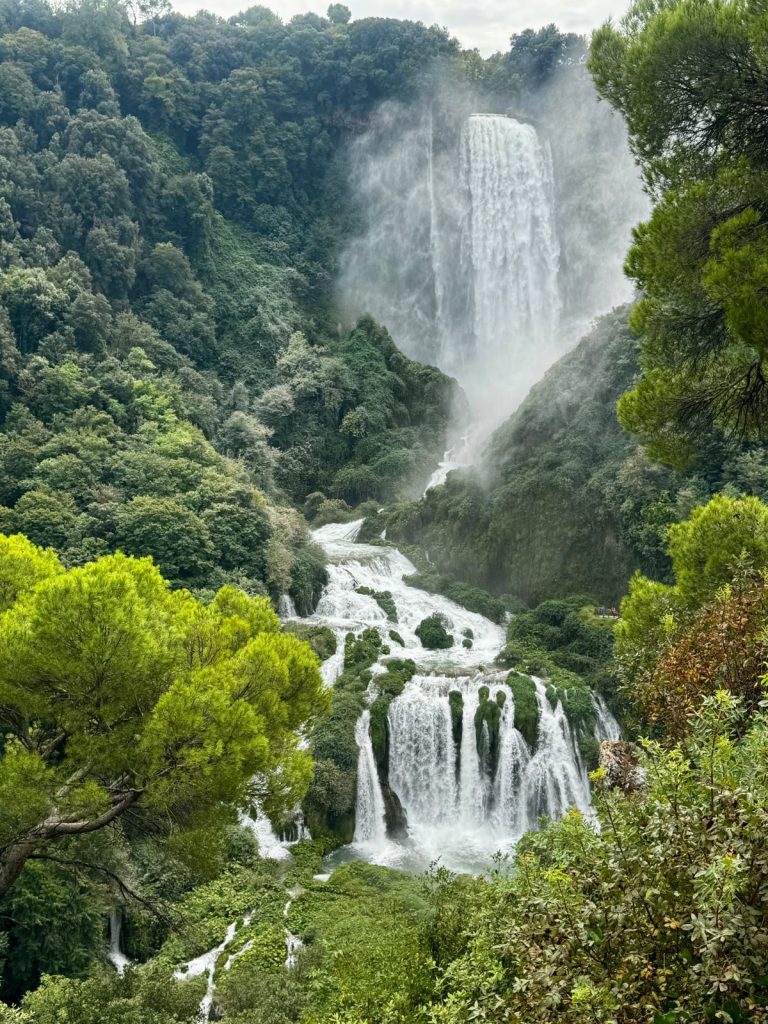
 I am in between caminos, having completed the Camino Primitivo in Spain in late September, and the first of two Cammino/Via De Francesco in Italy in early October. In a few days’ time, we’ll be embarking on the third. I’m taking this brief interlude to reflect, now that my body has caught up with itself. An initial thought was to ask myself why I keep walking the camino/cammino 16 times since 2022 clocking just under 2,000 kilometres? If it’s to alleviate boredom, walking over 3 million steps, one foot in front of the other repetitively, is a definition of boredom.
The In-Between Spaces
The paradox of the camino is that it is precisely boredom that sits across from frenetic. Most of us can attest to the frenetic nature of our lives – buzzing with ceaseless activity. Walking the camino, at least for me, allows me to enter the in-between spaces so my brain has the margins it needs to re-centre, re-calibrate, re-focus, on what’s truly important. As sentient beings (which humans are), wired for movement, walking is that one human activity that synchronizes body, mind, and spirit. It places it into a cadence that is hard to find in any other human activity (refer to the blog on ‘Walking at the Speed of Life’).
The Paradox of Life
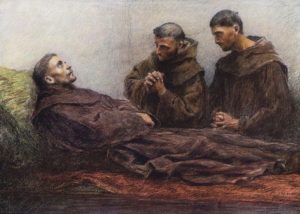
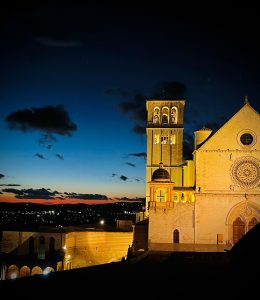
The Cammino De Francesco traces the area that St Francis of Assisi covered during his lifetime. This year marks the 800th anniversary of his death and it was particularly moving to be in the same space geographically where the poor man of Assisi left such an indelible mark on history. In this painting of Francis, he is nearing the end of his life. He was experiencing severe physical suffering and eye disease which left him almost blind.
‘Canticle of the Creatures’ was composed by St. Francis around 1225, in this weakened physical state near the end of his life in 1226. Yet, ‘Canticle of the Creatures’ is perhaps the most beautiful expression of St. Francis’ spirituality. He does not simply praise God for creation, but praises God through creation! This image captures a remarkable Franciscan paradox – a man whose physical world was becoming dark could still sing about the beauty of creation!
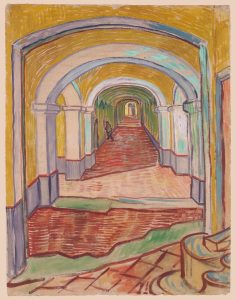 In the in-between spaces of my time in Italy, I have been visiting art museums. A Vincent Van Gogh painting here in Rome, ‘The Gardener’ (1889), was painted in the asylum garden of St-Remy where he committed himself and was there for 12 months. This led me to another painting while he was in the asylum, housed in The Metropolitan Museum of Art in New York City. ‘Corridor in the Asylum’ was also an 1889 painting where he captures the interior view of one of the asylum’s corridors. Despite his colourful palette of picturesque wheat fields, olive groves, cypresses, roses, and irises in and around the monastery, the asylum corridor feels hollow and haunted. A man recedes into the background, engulfed by the hollowness. Not having found the cure he had hoped for at the asylum, Vincent died by suicide shortly thereafter.
650 years separate these two incredible human beings – Francis of Assisi (1182-1226), and Vincent Van Gogh (1853-1890). The former a radiant radical who turned poverty and creation into love. The latter, a tormented visionary who turned suffering into radiant colour. Whether suffering physically or mentally, on a bed of stone or in an asylum, the paradox of suffering is that it can be the precise gateway to seeing and creating beauty, both in the natural world around us and through the mind’s eye ‘within us’.